

How To Draw Production Possibilities Frontier
The production possibility frontier (PPF) is a graph that shows all maximum combinations of output that an economic system can achieve, when available factors of product are used effectively. Information technology is also known as the transformation bend or the production possibility curve.
The PPF is a great concept considering information technology beautifully illustrates two of the most fundamental economical concepts: trade-offs and opportunity costs. That is, it shows how much of a good or service must be given up in order to get more of another good or service.
In the following paragraphs we will look at how to describe a production possibility curve, how to interpret it and how it is related to the concept of Pareto efficiency. So, allow's get started.
Drawing a Product Possibility Frontier
The best manner to explain how to depict a production possibility frontier is to look at a unproblematic instance. Allow'due south imagine an economy that just produces two goods: burgers and hot dogs. These 2 products (i.e. the burger and the hot dog industries) together use all the economy'due south available factors of production.
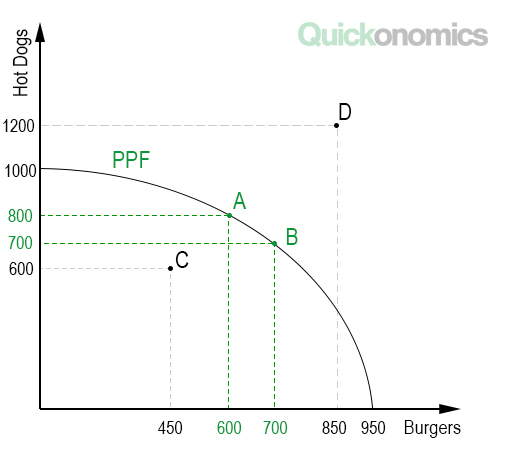
If all available resources are used to make burgers, the economy can produce a total 900 burgers and 0 hot dogs. By contrast, if all resources are dedicated to the production of hot dogs, the economy can produce 1,000 burgers. These 2 extremes mark the finish points of the production possibility borderland. That is, they indicate the x-intersect and the y-intersect of our curve (see below).
Of grade, the economic system can also determine to divide its resources betwixt the production of burgers and hot dogs. There are countless combinations of the 2 goods that can be produced at full capacity. To draw the product possibility bend, we tin can plot a few of those combinations in the diagram and simply connect them to become the full PPF.
For instance, let'south say our economy can produce 600 burgers and 800 hot dogs (Signal A). Alternatively it can also produce 700 burgers and 700 hot dogs (Point B). If we plot these points in the diagram (run into below) and connect them with the 10-intersect and y-intersect, we tin can approximate the total PPF. Annotation that the more points we have, the more accurate our PPF volition be.
Product Possibility Frontier and Opportunity Costs
As mentioned in a higher place, the production possibility frontier is a beautiful illustration of opportunity costs. It shows the merchandise-offs companies or individuals face up when they have to decide how to allocate their limited resources between two alternatives. Or in other words, the PPF shows, how much of expert A must be given upwards in order to get more than of good B and vice versa.
For example, if nosotros take another look at the illustration above, nosotros tin see that the economy has to give upwards 100 burgers if it wants to increase production of hot dogs from 700 to 800. Thus, the opportunity cost of these 100 burgers is exactly 100 hot dogs. Similarly, to increment production of burgers from 0 to 600, the economy has to reduce product of hot dogs from 1000 to 800. Hence, at this point the opportunity cost of 600 burgers is 200 hot dogs.
Pareto Efficiency
In addition to opportunity costs, the PPF also illustrates the concept of Pareto efficiency. Co-ordinate to this concept, an economic output is efficient when it'south impossible to make ane political party better off without making another party worse off. Or in our case, when it is impossible to produce more of Skillful A without producing less of Skillful B.
This holds true for all points that lie on the PPF. Because the PPF marks the maximum output combinations, it is not possible to increase the output of one skilful without reducing the output of the other. Meanwhile, all points below the curve are considered inefficient, because in those cases total output of both goods tin be increased at the same time, which means the economy is not operating at full capacity (i.east. efficiently). Finally, allpoints to a higher place the curve are impossible to reach, because they would require a higher product capacity. Hence the name, production possibility frontier .
For example, it is not possible for our imaginary economy to produce any combination of hot dogs and burgers in a higher place the PPF (e.g. Point D), because there are not plenty resource available to attain this output. However, the economy is non working at full capacity when it produces an output below the PPF, like Point C. In this example, information technology could nonetheless increase production of burgers without producing fewer hot dogs and vice versa.
In a Nutshell
The product possibility frontier (PPF) is a graph that shows all maximum combinations of output that an economy can achieve, when bachelor factors of production are used effectively. The PPFillustrates how much of a adept or service must exist given upwardly in order to go more of another good or service. In improver to that, the PPF likewise illustrates the concept of Pareto efficiency. All points that lie on the PPF are pareto efficient, whereas all points beneath the PPF are considered inefficient.

Source: https://quickonomics.com/how-to-draw-a-production-possibility-frontier/
Posted by: fernandezexedger.blogspot.com
0 Response to "How To Draw Production Possibilities Frontier"
Post a Comment